Saola
Scientific name: Pseudoryx nghetinhensis
Critically Endangered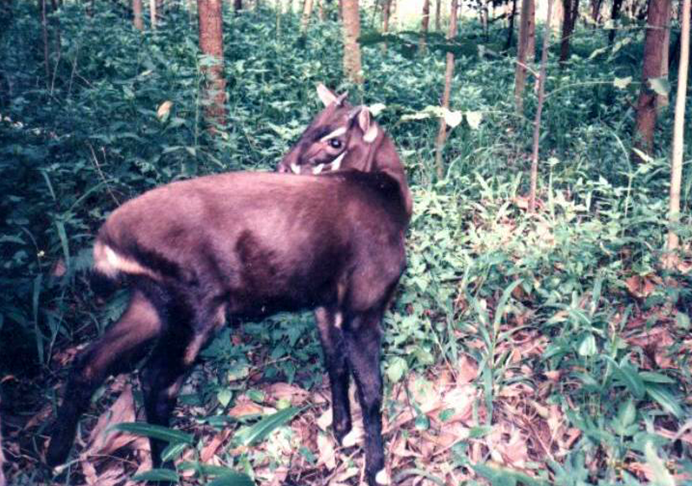
Common name: Saola
Scientific name: Pseudoryx nghetinhensis
Conservation status: Critically Endangered
Primary range: Annamite Mountains of Vietnam and Laos
Diet: Leaves, grasses, herbs, and other vegetation
About the Saola
Saola have been given the name “the Asian unicorn” because not much has been revealed about them since they were discovered. The species is currently critically endangered, and none exist in captivity, so camera-trap photographs are one of the few ways to view them.
In May 1992, the saola was first discovered by scientists during a joint survey carried out by the Ministry of Forestry of Vietnam and WWF in north-central Vietnam. The discovery was the first large-mammal discovery in more than 50 years and was considered one of the most magnificent zoological discoveries of the 20th century.
Habitat and Range
Saola are known to inhabit only the slopes of the Annamite Mountains, a restricted mountainous jungle region along the northwest-southeast border between Vietnam and the Lao People’s Democratic Republic (Laos). It is believed that saola live in mountain forests during the wet season and travel to the lowlands during the winter.
Since their discovery, saola have only been seen alive on rare occasions. There have been only four instances in which researchers have observed saola in the wild.
Habitat Characteristics:
- Subtropical/tropical moist environment
- Deciduous woodlands
- Edge zones of the forest
Physical Characteristics
The saola resembles an antelope, but its DNA has shown that it is closely related to cattle. Saola are approximately 35 inches tall at the shoulder and weigh around 176 to 220 pounds.
Common physical attributes:
- Two long, straight, parallel horns
- Sleek and dark brown fur
- Dappled white markings on the face
Diet and Behavior
Saola have been known to eat leafy plants, fig leaves, and stems near rivers and along animal trails. Saola have occasionally been seen in groups, but they appear to be primarily solitary animals with relatively large home ranges.
Behavior:
- Believed to be territorial
- Solitary
Major Threats
Increasing demand from urban populations is causing saola to be hunted at a greater rate for meat and medicine. Deforestation is also a threat to the saola population because clearing forests for farming and infrastructure pushes saola into smaller areas.
Threats Saolas Face:
- Hunting
- Habitat loss
Conservation Efforts
For the past 20 years, the IUCN Species Survival Commission’s Asian Wild Cattle Specialist Group has operated the Saola Working Group to protect the saola. The World Wildlife Fund has also worked to protect the saola since its discovery, focusing on strengthening and establishing protected areas, conducting research, and supporting community-based forest management.
Conservation Efforts That Have Been and Can Be Taken:
- Preventing poaching
- Establishing new saola reserves
- Improved community-based forest management
Why the Saola Matters
Due to its rarity and irreplaceability, the saola has become a symbol of the Annamite Forest for Laos and Vietnam. The number of saola currently inhabiting the region is believed to be only a few hundred to a few dozen.
Saola are not specifically targeted by most hunters, but they are often killed while hunters are pursuing other wildlife. Bears and tigers are hunted using snares, which not only diminishes their populations but also affects the saola population.
Conservation Challenges
Since there are currently no saolas in captivity, there is no backup population for those in the wild. This means that if the last few wild saolas disappear, the species will be gone forever.
Challenges They Face:
- Deforestation
- Snares
- Lack of captive breeding